
The Travel Industry's Next Platform Shift Won't Look Like the Last One
- Tom

- 6 days ago
- 3 min read
Updated: 5 days ago
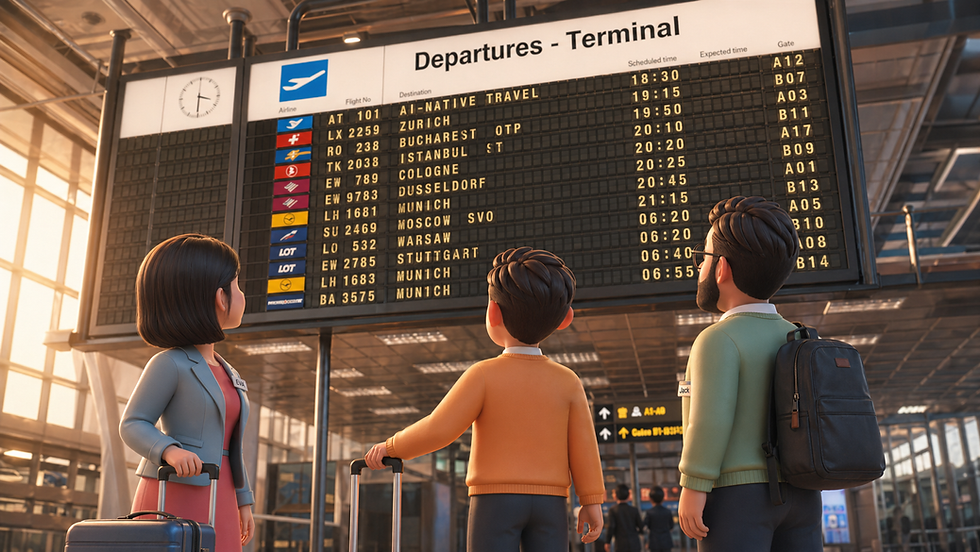
The last time travel distribution was fundamentally restructured, it took about a decade. The GDS consolidation of the 1990s, the OTA wave of the early 2,000s — these shifts reshaped who controlled inventory, who owned the customer relationship, and which intermediaries survived.
We're at the beginning of another one. And this time, the enabling technology isn't a faster search interface or a better booking flow. It's autonomous AI agents.
What changes when agents make the decisions
Today, travel procurement — whether for a business traveler booking a flight or an agency sourcing hotel inventory for a group — is fundamentally a human-guided process. Humans define parameters, compare options, and confirm decisions. Technology accelerates that process, but the cognitive load stays with the person.
AI agents change the architecture. When an agent can understand a travel brief, query multiple inventory sources, apply policy constraints, and execute a booking — without a human touch point at each step — the whole model of how agencies and suppliers interact needs to be rethought.
Early deployments are already showing that agentic workflows can compress what used to be multi-step, multi-day procurement processes into minutes. The question isn't whether this will happen. The question is who designs the infrastructure it runs on.
The constraint most people miss
There's a widespread assumption that AI will simply be layered on top of existing distribution infrastructure — that the GDS, the OTA, and the TMC will remain structurally intact, with an AI wrapper added on top. We think that's wrong.
Agent-native distribution requires different things from the data layer: real-time availability without rate limits, structured policy APIs, dynamic pricing that responds to agent logic, and audit trails designed for automated decision-making. None of that is what existing infrastructure was built to deliver.
The platforms that will define this next era won't be the ones that added AI to a legacy stack. They'll be the ones that designed the stack for AI from the start.
The platforms that will define this next era won't be the ones that added AI to a legacy stack. They'll be the ones that designed the stack for AI from the start.
Why travel agencies are the right place to start
It might seem counterintuitive to begin with agencies rather than suppliers or enterprise buyers. But agencies sit at exactly the right intersection: they manage complex, high-frequency procurement decisions; they have established trust relationships with both suppliers and corporate clients; and they're under enough margin pressure that efficiency gains translate immediately into competitive advantage.
An agency that can deliver the same quality of service with a fraction of the operational overhead isn't just more profitable. It's structurally more defensible in a market where the largest platforms have unlimited technology budgets.
That's the bet we're making at Bitravel — and why we're building for agencies first.
What you'll find here
This blog is where we share what we're seeing as the infrastructure for AI-native travel distribution takes shape. We won't cover every AI press release in the industry. We'll write about the things that matter: structural shifts, adoption patterns, policy constraints, and market dynamics that will determine who wins the next decade in travel.
If you're a travel agency owner, a supplier thinking about distribution strategy, or an investor trying to understand where the leverage points are — this is the right place to pay attention. Sign up to our blog feed.
Comments